How Is Craniosacral Therapy Different from Massage?
The question comes up often, usually from someone who has been referred by a massage therapist or a friend who struggles to describe what craniosacral therapy actually is. Both involve a practitioner's hands and a treatment table. Both can produce deep relaxation. The similarities end there. What massage and craniosacral therapy are actually doing, in the body, to the body, with the body, is quite different, and understanding that difference helps explain why each one is suited to different situations, and why many people end up using both.
What massage does
Massage is what researchers call a mechanotherapy: it works by applying physical force to soft tissue. Techniques vary across Swedish, deep tissue, and myofascial release, but the through-line is consistent. The practitioner uses pressure, movement, and friction to act directly on muscles, fascia, and connective tissue. The effects are real and well-documented. Research from the University of Kentucky's Department of Physical Therapy describes massage as imparting "biologically relevant mechanical stimulation" to skeletal muscle, changing how the tissue responds, recovers, and repairs.
The nervous system benefits too. Moderate pressure activates parasympathetic pathways, reducing heart rate and cortisol. Fascial tissue releases. Circulation improves at the microvascular level. These are meaningful, measurable outcomes.
Skilled massage requires deep knowledge of anatomy, an ability to read tissue response, and the judgment to calibrate pressure to each individual. It is purposeful, targeted work. What defines it, at its core, is that the practitioner is doing something to the tissue.
What craniosacral therapy does
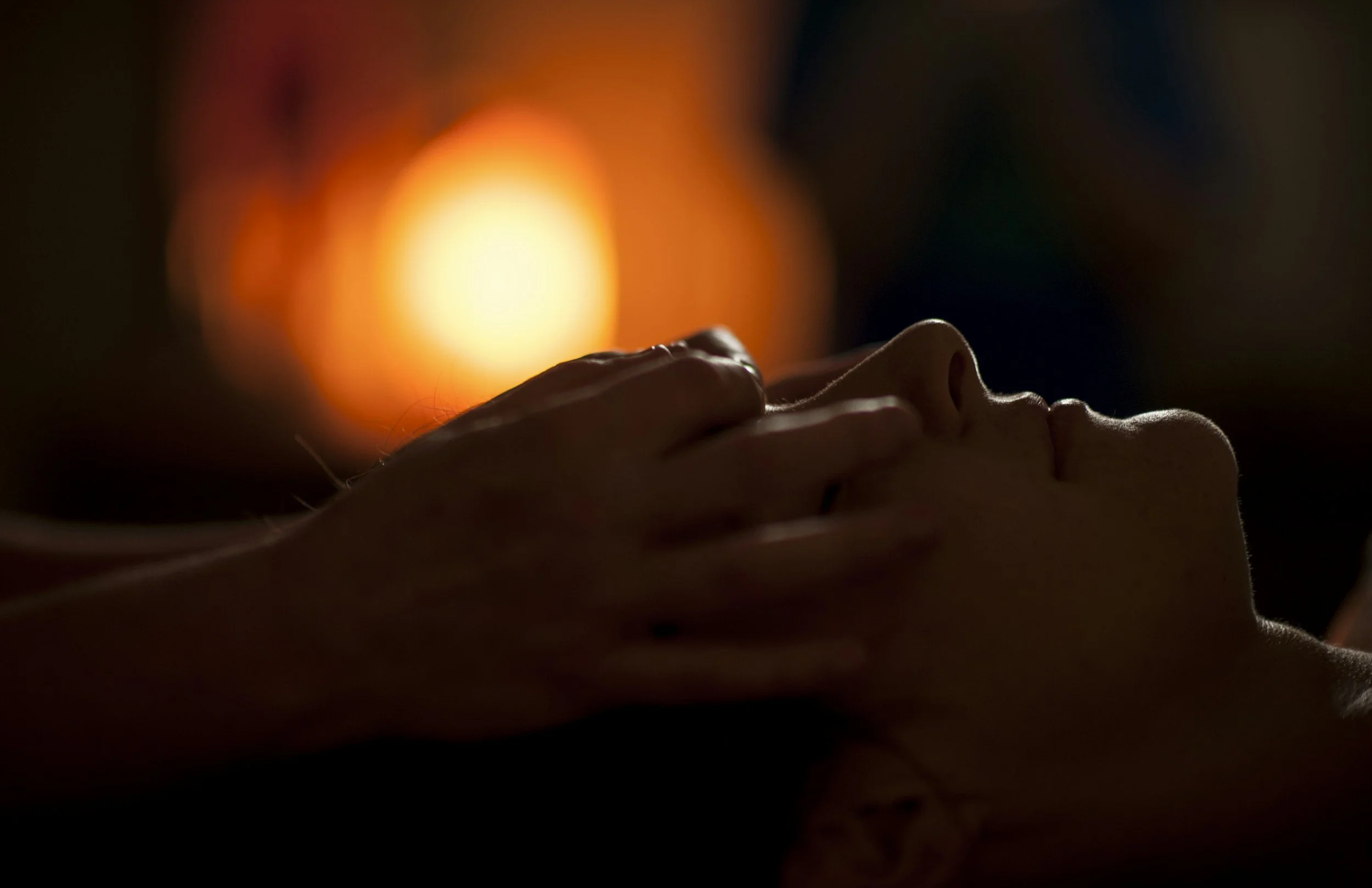
Craniosacral therapy is not a mechanotherapy. The touch involved, about the weight of a nickel, is too light to compress or mobilize muscle tissue in any meaningful way. This is not a limitation of the work. It is the point.
What a CST practitioner is working with is the craniosacral system: the membranes and cerebrospinal fluid that surround and protect the brain and spinal cord, running from the cranium to the sacrum. This fluid moves in a subtle, rhythmic cycle that trained practitioners learn to detect through palpation. Where massage applies force to produce change, CST uses a quality of listening touch to find where the system is restricted, then creates the conditions for the body to release those restrictions from within.
The practitioner is not doing something to the tissue. They are attending to what the body is already doing and working with it.
One practical consequence of this distinction is accessibility. Because CST does not compress or mobilize muscle tissue, it is appropriate for people who cannot tolerate conventional massage: those with fibromyalgia, acute inflammation, a nervous system that tightens rather than releases under pressure, or a trauma history that makes deeper work counterproductive. It is also appropriate for newborns, whose craniosacral systems are often affected by the mechanical demands of labor and birth.
Why the two modalities often recommend each other
These are not competing approaches, and practitioners in both fields tend to understand that clearly. Many massage therapists train in CST as a complement to their existing work, recognizing that there are situations where adding force to the equation is not what a client's body needs. Many CST practitioners refer clients for massage when muscular tension or fascial restriction is what's primarily at play.
The populations they serve overlap considerably. Both modalities attract people dealing with chronic tension, stress, and nervous system dysregulation. But the mechanism of action is different enough that one can reach things the other cannot. A body carrying deep muscular tension and fascial adhesion may need the mechanical work of massage. A nervous system locked in a chronic protective pattern, alert, guarded, unable to downregulate, may need something that doesn't add more input to the system.
In practice, the two approaches can on occasion, depending on the issues presented, be powerful in sequence. Massage addresses what can be reached through the muscles and fascia. CST addresses central nervous system and fascial restrictions that impact flow of cerebral spinal fluid.
What to expect if you've had massage but not CST
For someone accustomed to massage, a craniosacral session can feel surprising at first. The touch is so light that it can be difficult to believe anything is happening. What most people notice, once they settle in, is a progressive deepening of relaxation that feels qualitatively different from the muscular release of massage. There is often warmth, a subtle sense of internal shifting, or a feeling of something unwinding slowly and on its own terms.
Unlike massage, there is no soreness afterward. There is no effort required from the client. Many people describe the quality of rest that follows as unusually deep: a settling that goes below the level of muscles into something harder to name but clearly felt.
If you've been receiving massage and find that certain things don't fully resolve, or if you're someone for whom deeper pressure hasn't felt helpful, craniosacral therapy is worth understanding on its own terms.
Nancy Bradshaw is a Licensed Occupational Therapist with more than 30 years of healthcare experience and craniosacral therapy training through the Upledger Institute. Her practice, Light Touch Craniosacral Therapy, serves women and infants in Jacksonville, Florida. If you have questions about whether CST might address something you've been navigating, she's glad to talk through it before you commit to anything.
Ready to experience it for yourself?
Craniosacral therapy is not a substitute for medical care. Please consult your healthcare provider regarding any medical concerns.
Sources
Van Pelt DW, Lawrence MM, Miller BF, Butterfield TA, Dupont-Versteegden EE. Massage as a Mechanotherapy for Skeletal Muscle. Exercise and Sport Sciences Reviews. 2021;49(2):107–114. PMC8320327
Haller H, Lauche R, et al. Craniosacral Therapy for the Treatment of Chronic Neck Pain: A Randomized Sham-Controlled Trial. Clinical Journal of Pain. 2016. PMC4894825
Upledger Institute International. Craniosacral Therapy. upledger.com